How to Tell If a Crystal Is Real in 30 Seconds
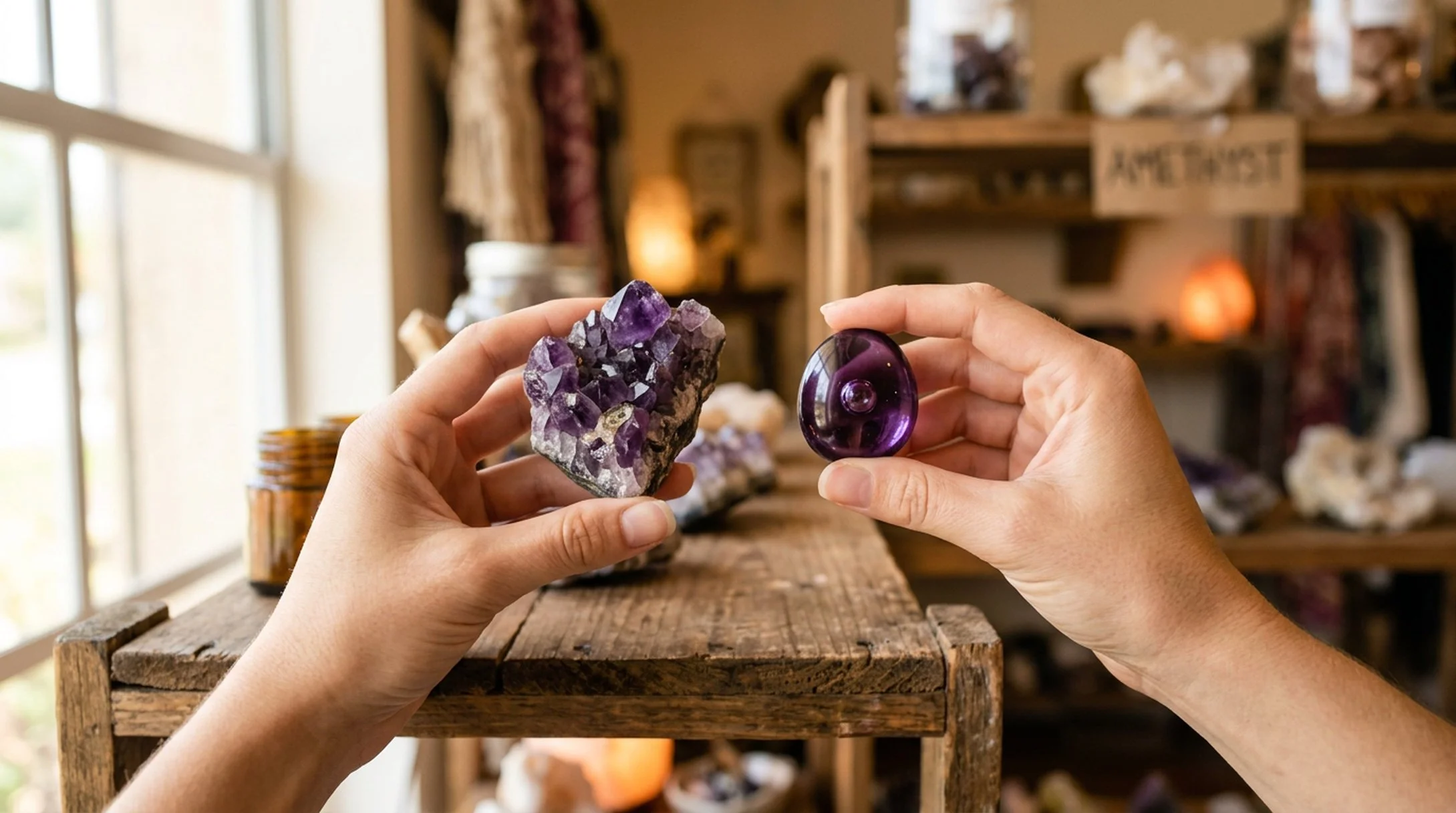
You picked up an amethyst at the boardwalk market, grabbed a "raw crystal set" off TikTok for $11, or got a stone as a gift and now you are not sure what you actually own. Learning how to tell if a crystal is real takes about 30 seconds per stone once you know what to check. This guide covers the most common fakes circulating the crystal community, four quick physical tests, the pricing red flags that give a fake away before you buy, and what to do if a piece you already own looks suspicious.
Why Fakes Are So Common in Tourist Markets and Online
Knowing how to tell if a crystal is real matters most where fakes are concentrated: tourist shops, beach boardwalks, flea markets, and bulk online sellers.
Fakes have gotten more convincing in the last few years. Resin and glass copies now include painted-on "inclusions," dye patterns that mimic real banding, and rough rock matrix glued to the bottom to look like a natural geode. A piece that would have failed a basic test five years ago can fool a beginner today.
Some so-called fakes are real material with a wrong label: heat-treated amethyst sold as natural citrine, dyed howlite sold as turquoise, manmade opalite glass sold as moonstone. The material is real, just mislabeled.
The Five Most Common Fakes Sold in Southwest Florida
"Amethyst" that is purple-dyed glass. Often has round air bubbles trapped inside and an unnaturally even color.
"Citrine" that is heat-treated amethyst. The stone itself is real quartz, but natural citrine is rare and looks softer yellow, never burnt-orange at the tips.
"Turquoise" that is dyed howlite. Howlite is naturally white with grey veining, and dye soaks unevenly into the cracks.
"Moonstone" that is opalite. Opalite is a manmade glass with a rainbow-blue shimmer, no natural sheen layers.
"Aura" or "rainbow" stones with a vapor coating. The underlying quartz is real, but the metallic rainbow finish is a coating, not a natural feature.
How to Tell If a Crystal Is Real in 30 Seconds
Four quick tests you can run with no equipment:
Weight test. Real crystals feel surprisingly dense. Pick the piece up. If it feels lighter than a similar-sized garden rock, suspect resin or hollow glass.
Temperature test. Real stones stay cool to the touch even in a warm Florida shop. Hold the piece in a closed hand for 30 seconds. Glass and resin warm to skin temperature fast. Real quartz, agate, or jasper still feels cool.
Look for natural imperfections. Real crystals have inclusions, cloudy zones, asymmetric growth, and small natural chips. A perfectly clear, perfectly purple fist-sized amethyst priced at $12 is almost always dyed glass.
Check for bubbles and mold seams. Hold the stone up to a window. Glass fakes show round air bubbles suspended inside. Resin fakes often have a visible mold seam line.
These four tests are the foundation of how to tell if a crystal is real, and they catch most of what shows up at Florida tourist markets and on bulk online listings.
What Real Crystals Actually Cost (And the Pricing Red Flags)
Pricing is the fastest red flag of all. A rough framework for real stones at honest market prices:
Budget tier covers tumbled stones and small raw pieces, where real options absolutely exist. Mid tier covers palm stones, hand-sized clusters, and small towers, which is where most reputable shop inventory sits. Premium tier covers cathedral geodes, statement clusters, and rare specimens, which climb fast based on size and grade.
Watch for these pricing red flags:
A basketball-sized amethyst geode for $25. Real geodes that size run into the hundreds at wholesale.
A 100-piece raw crystal grab bag for $15. The math does not work. The contents are pebbles, dyed quartz, or resin.
"Free crystal with purchase" promotions almost always include dyed howlite or resin tumbles.
If a price feels too good to be true, your gut is usually right.
Why Shopping In Person Beats Online for First-Time Buyers
The single best way to skip the guesswork on how to tell if a crystal is real is holding the stone in your hand before buying it. At Crystals & Collections on South Tamiami Trail, every piece is hand-selected and ethically sourced. You can run the weight test, the temperature test, and the inclusion check right in the shop, and we will tell you exactly what variety each piece is, whether it is natural or treated, and what to expect over time.
If you are building a first collection, browse the full shop for tumbled starter sets, or come in and we will help put together a small group of authentic pieces.
Visit the Shop or Bring In a Piece for a Second Look
Stop by 16387 S. Tamiami Trail, Unit J, Fort Myers, FL 33908, or call (239) 270-5802 before you drive over. If you already own a stone and want help figuring out how to tell if a crystal is real, bring the piece in for a second look. You can also reach out through our contact page and we will respond within one business day.
